
Helioviewer Boosts Sunspot Study with Modernized Analysis
A new study investigating sunspots and solar cycles highlights how NASA’s Helioviewer data visualization tool supports scientific discovery and optimizes analysis. Compressed images of the Sun from Helioviewer served as the primary source material in the paper ‘Investigating Solar Cycles Using Mathematical Morphology’, published in the journal Solar Physics. Helioviewer files are much smaller and faster to process than the large scientific data files typically used in analysis, making inclusion in this study promising for future solar physics research applications that can be accelerated using Helioviewer images.
The Helioviewer team is thrilled to be recognized in this paper and proud to support NASA’s open science initiative to create data analysis tools that can be easily discovered and accessed around the world.
A New Take on Sunspot Analysis
In the study, a research team in Brazil processed and analyzed around 10,000 images of the Sun from the Helioviewer database, originally captured by the ESA-NASA Solar and Heliospheric Observatory (SOHO) and NASA’s Solar Dynamics Observatory (SDO) satellites.
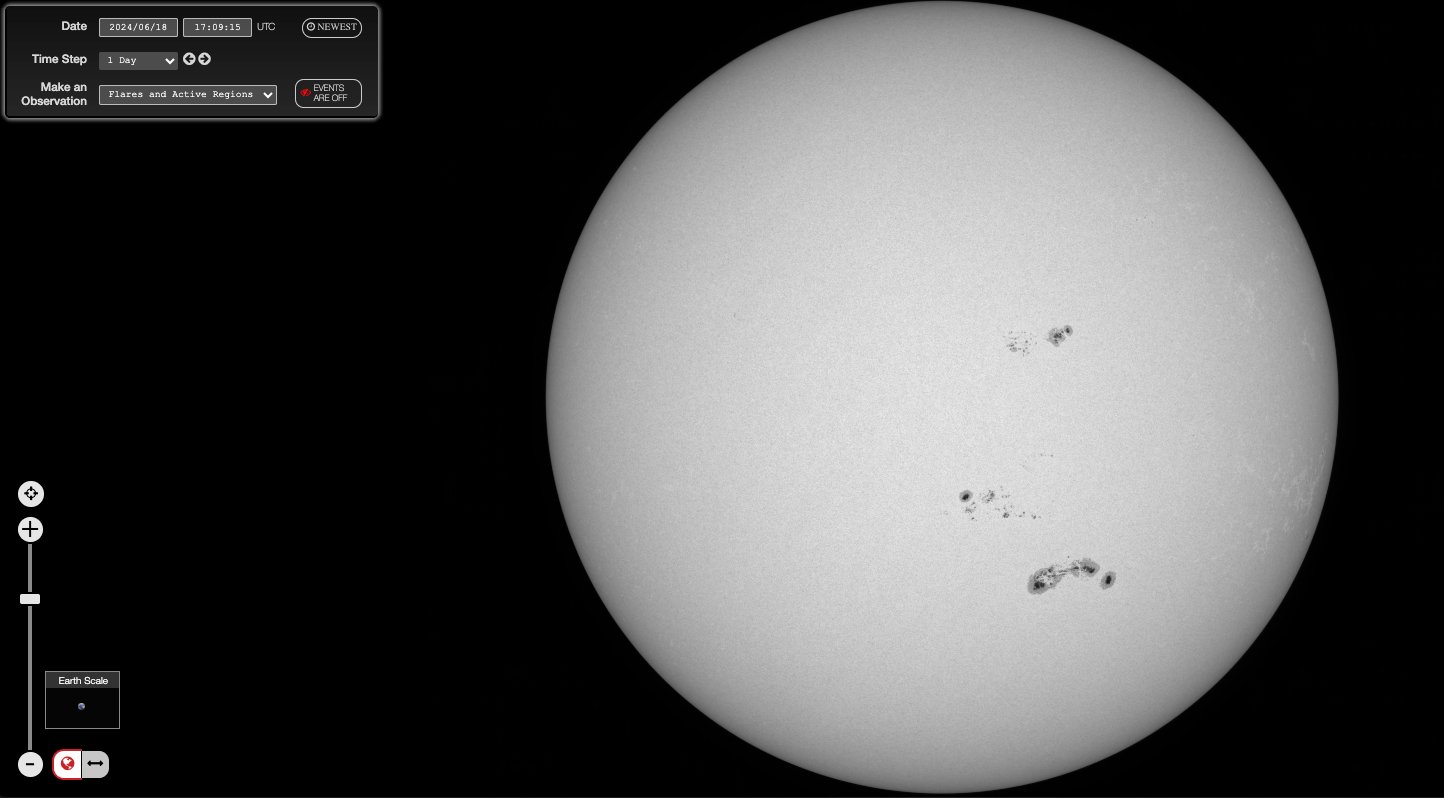 Helioviewer allows users to see sunspots and download images in
JPEG 2000 format.
Credit: Helioviewer
Normally, solar science researchers use a raw scientific data format called FITS (Flexible Image Transport System), which is very large and takes a long time to work with. This team instead chose to utilize Helioviewer files, which are compressed using the JPEG 2000 format and retain the visibility of large scale features like sunspots. The 10,000 images used in this study only take up about 10 gigabytes (GB) of storage space as JPEG 2000 files but would take up roughly 150 GB as FITS files, significantly impacting download and processing times.
“It’s just a quicker way to get an image of the Sun,” said Jack Ireland of NASA’s Solar Data Analysis Center, explaining the benefits of JPEG 2000 images for this type of analysis. “You don’t have to wait ten times as long.”
The team leading the study developed a program called PyMoST (Python Morphological Sunspot Tracker) using the Python programming language to identify and automatically track 52,000 sunspots in the compressed Helioviewer images and analyze their physical evolution in solar cycles. They also incorporated the Python code hvpy created by the Helioviewer team that allows users to download data easily.
Correlated Results
The paper compared findings of its sunspot survey using JPEG 2000 images to similar studies that used FITS files and found no impact on results, proving that using compressed files from Helioviewer is a credible and efficient option for sunspot analysis.
This validation shows promise for using JPEG 2000 images in future research applications to identify other large scale features of the Sun, including solar active regions and coronal holes, when fine details captured in FITS data are not necessary for analysis.
“Anything you can see with your eye you can probably see with a JPEG 2000,” Ireland said. “The science is there to be uncovered.”
The data used in this study was independently discovered and obtained from Helioviewer in a testament to the tool’s global reach, reliable infrastructure and accessibility within an open science framework. The Helioviewer team encourages researchers to explore the scientific analysis capabilities of JPEG 2000 images and supports efforts within NASA to integrate this format into more data visualization and modeling tools.