
Helioviewer Events API Released for Public Use
The Helioviewer Events API is now open for public use, and it is the source of all solar events you see on helioviewer.org. Solar event catalogues come from many places, and each one has its own format, its own coordinates and its own way of naming things. The Events API collects them, puts them into one event model, and serves them through one REST API.
Today it serves events from:
- HEK, the Heliophysics Event Knowledgebase: all event types
- CCMC DONKI: solar flares and coronal mass ejections
- CCMC Flare Scoreboard: flare predictions from the scoreboard models
- WSA: coronal-hole maps and magnetic-connectivity footpoints
- RHESSI: the RHESSI flare list
The API is live at https://events.helioviewer.org.
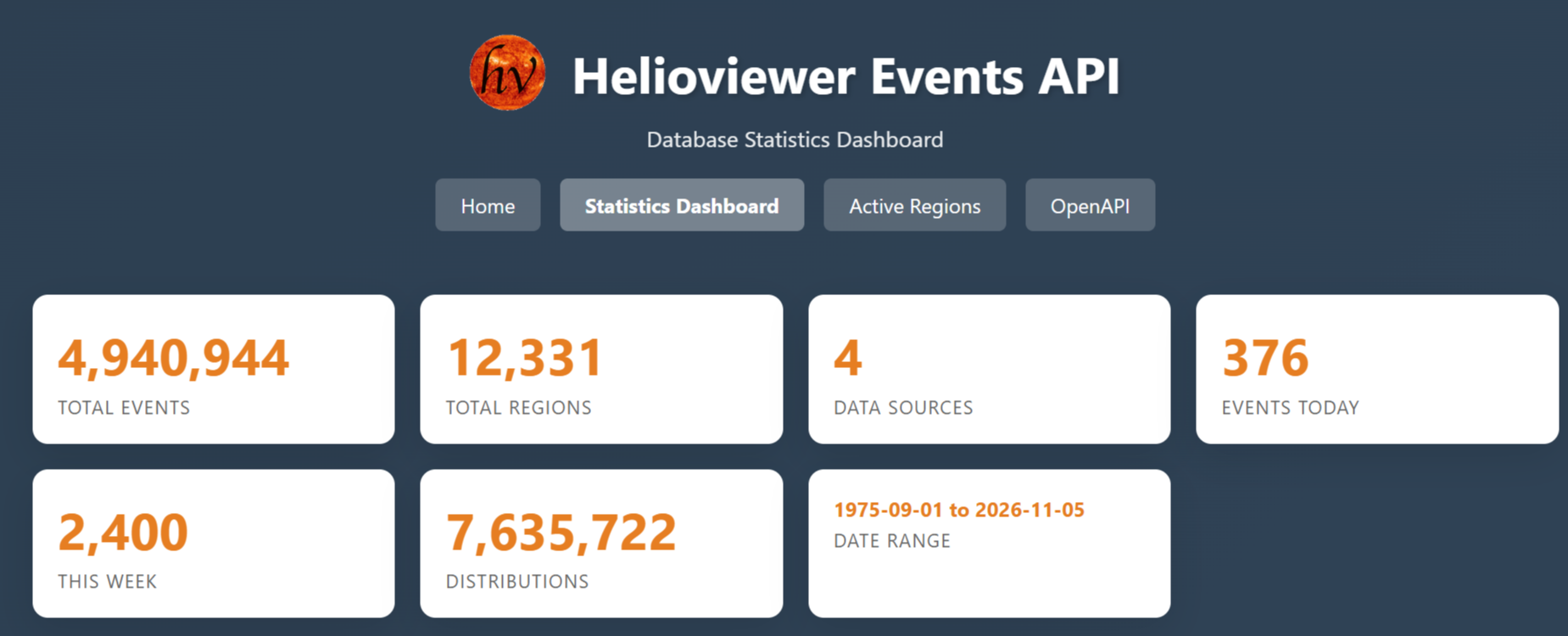
As of today, the Events-API holds almost 5 million events, going back to 1975.
Features
- One event model for every source: the same fields for a HEK flare, a DONKI CME or a WSA coronal hole.
- Positions served in helioprojective arcseconds, rotated to the observation time you ask for.
- Event regions (footprints) as lists of polygons, so an event with many contours, like a coronal-hole map, comes as one event.
- Events behind the Sun are flagged, not dropped. Your client decides how to draw them.
- The original record from the provider is available for every event.
- Events are linked to NOAA and HARP active regions, and you can list all events of one region.
- Kept up to date: the current day is collected again every few minutes.
- Open source, Apache 2.0 license.
Open for public use
- OpenAPI / Swagger UI: https://events.helioviewer.org/api-docs
- OpenAPI spec: https://events.helioviewer.org/openapi.json
For example, all HEK events active at one moment:
import requests

url = "https://events.helioviewer.org/api/v1/events/HEK/observation"
events = requests.get(f"{url}/2025-03-15T12:00:00Z").json()
Other public endpoints give a single event by id, its original source record, the latest updated events, and the active regions with their events. There is also an active regions search page.
Integrated into helioviewer.org
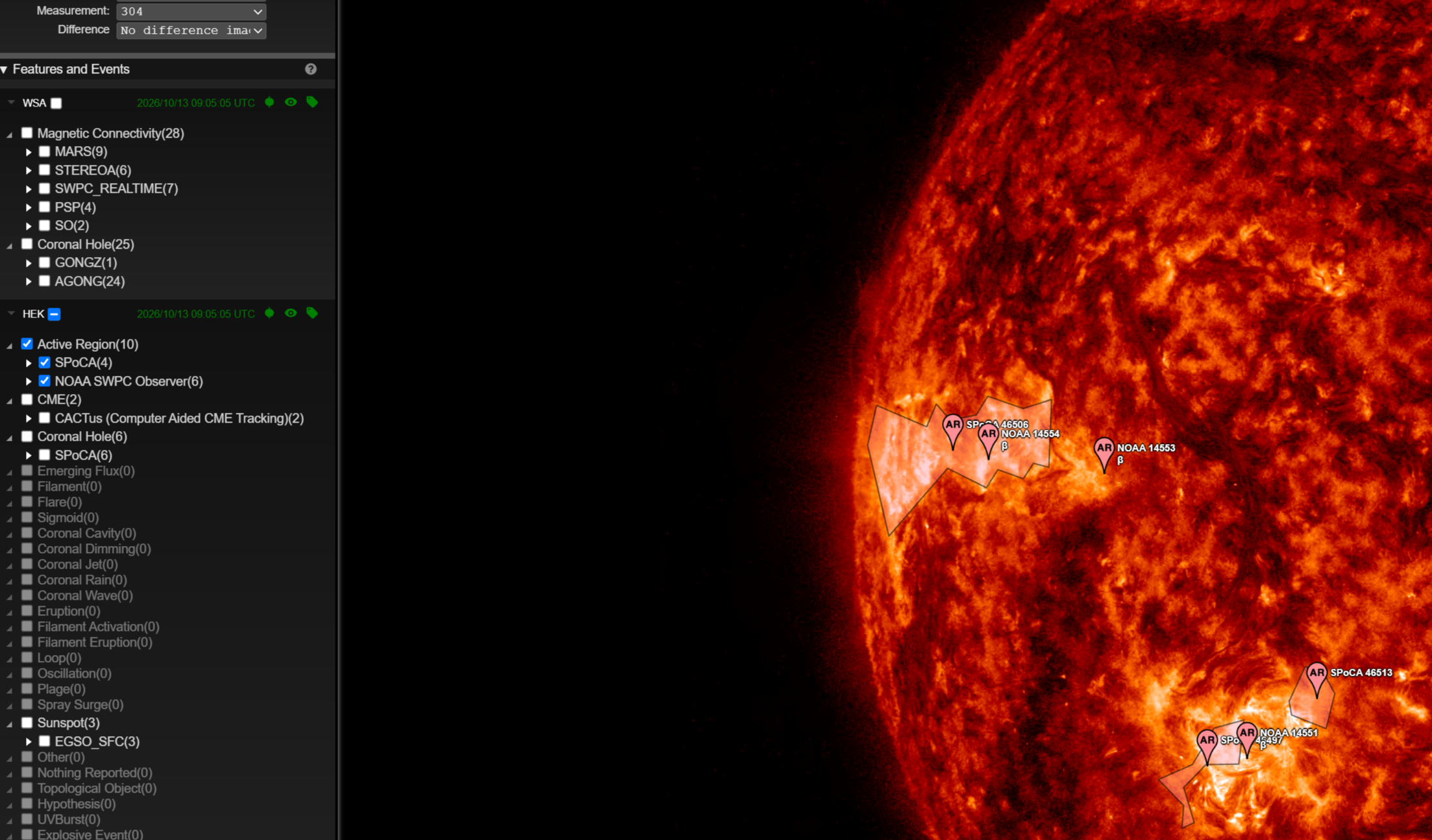
helioviewer.org now uses the Events API to retrieve the features and events shown in the interface. In the viewer, open Data Sources > Features and Events and pick any source: HEK, CCMC, WSA or RHESSI.
- The events tree in that panel is the event-tree React component described below.
- Event regions are drawn from the API footprints, also when an event has many contours.
- Event markers and regions follow the time you are looking at, because the API rotates positions to that time.
- Events you select also go into your screenshots and movies.
- Clicking a marker opens the event details, with a link to the event’s JSON in the Events API.
The event-tree React component
The events tree you see in helioviewer.org is a small React component, and it is also open for public use. With it you can bring solar event listings into your own React project: it loads the events for a date, groups them in a tree, and lets users select them with checkboxes. Your app gets the selected events back through a callback.
npm install @helioviewer/event-tree
import HelioviewerEventTree from '@helioviewer/event-tree';

<HelioviewerEventTree
  source="HEK"
  eventsDate={new Date()}
  onEventsUpdate={(events) => console.log(events)}
  onHoveredEventsUpdate={(ids) => console.log(ids)}
/>
- Demo: https://helioviewer-project.github.io/event-tree/
- npm: @helioviewer/event-tree
- Source: github.com/Helioviewer-Project/event-tree
Links
- Events API: https://events.helioviewer.org
- API reference (OpenAPI): https://events.helioviewer.org/api-docs
- Events API source code: github.com/Helioviewer-Project/events-api
- event-tree component: github.com/Helioviewer-Project/event-tree
If you have questions or find a problem, please send us an email or file an issue on the Events API project page.