<?xml version="1.0" encoding="utf-8"?><feed xmlns="http://www.w3.org/2005/Atom" ><generator uri="https://jekyllrb.com/" version="3.10.0">Jekyll</generator><link href="https://helioviewer-project.github.io/feed.xml" rel="self" type="application/atom+xml" /><link href="https://helioviewer-project.github.io/" rel="alternate" type="text/html" /><updated>2026-03-06T19:53:23+00:00</updated><id>https://helioviewer-project.github.io/feed.xml</id><title type="html">Helioviewer Project</title><subtitle>Visualization of solar and heliospheric data</subtitle><entry><title type="html">Scheduled Maintenance (Corrected)</title><link href="https://helioviewer-project.github.io/2026/03/05/building-move" rel="alternate" type="text/html" title="Scheduled Maintenance (Corrected)" /><published>2026-03-05T05:00:00+00:00</published><updated>2026-03-05T05:00:00+00:00</updated><id>https://helioviewer-project.github.io/2026/03/05/building-move</id><content type="html" xml:base="https://helioviewer-project.github.io/2026/03/05/building-move"><![CDATA[<p>Correction: Helioviewer.org will be down starting Sunday, March 8, not the 9th as previously posted.</p>

<p>Starting Sunday, March 8, 2026 <a href="https://helioviewer.org">helioviewer.org</a> and other Helioviewer Project services will be brought down to accommodate a scheduled transition to a new location.
Users should expect outages and intermittent availability of helioviewer.org and other Helioviewer Project services for several days.</p>

<p>During this period users should expect the following:</p>
<ul>
  <li>helioviewer.org will be temporarily unavailable</li>
  <li>JHelioviewer users may not be able to load data from GSFC</li>
  <li>Helioviewer API and other services will be temporarily interrupted</li>
</ul>

<p>You may use the Helioviewer instance at <a href="https://helioviewer.ias.u-psud.fr/">IAS</a> during the maintenance window.</p>

<p>We apologize for any inconvenience and appreciate your patience during this planned downtime.</p>]]></content><author><name>Helioviewer Team</name></author><category term="Maintenance" /><summary type="html"><![CDATA[Correction: Helioviewer.org will be down starting Sunday, March 8, not the 9th as previously posted.]]></summary></entry><entry><title type="html">Scheduled Infrastructure Transfer Maintenance</title><link href="https://helioviewer-project.github.io/2025/07/29/infrastructure-transfer" rel="alternate" type="text/html" title="Scheduled Infrastructure Transfer Maintenance" /><published>2025-07-29T05:00:00+00:00</published><updated>2025-07-29T05:00:00+00:00</updated><id>https://helioviewer-project.github.io/2025/07/29/infrastructure-transfer</id><content type="html" xml:base="https://helioviewer-project.github.io/2025/07/29/infrastructure-transfer"><![CDATA[<p><a href="https://helioviewer.org">helioviewer.org</a> will be undergoing scheduled maintenance for infrastructure transfer over the next week.</p>

<p>During this maintenance period you can expect the following:</p>
<ul>
  <li>helioviewer.org may be temporarily unavailable</li>
  <li>JHelioviewer users may not be able to load data from GSFC</li>
  <li>Helioviewer API and other services may be temporarily interrupted</li>
</ul>

<p>This maintenance is necessary to transfer some infrastructure components to improve service reliability and performance.</p>

<p>You may use the Helioviewer instance at <a href="https://helioviewer.ias.u-psud.fr/">IAS</a> during the maintenance window.</p>

<p>We apologize for any inconvenience and appreciate your patience during this planned downtime.</p>]]></content><author><name>Helioviewer Team</name></author><category term="Maintenance" /><summary type="html"><![CDATA[helioviewer.org will be undergoing scheduled maintenance for infrastructure transfer over the next week.]]></summary></entry><entry><title type="html">New 3D Mode in Helioviewer.org</title><link href="https://helioviewer-project.github.io/2025/05/12/3d" rel="alternate" type="text/html" title="New 3D Mode in Helioviewer.org" /><published>2025-05-12T19:55:00+00:00</published><updated>2025-05-12T19:55:00+00:00</updated><id>https://helioviewer-project.github.io/2025/05/12/3d-helioviewer</id><content type="html" xml:base="https://helioviewer-project.github.io/2025/05/12/3d"><![CDATA[<p>We’re pleased to announce the addition of a new 3D mode to Helioviewer.org.
This new visualization capability expands how users can observe and study the
Sun and heliosphere directly through their web browsers.</p>

<h2 id="3d-visualization-capabilities">3D Visualization Capabilities</h2>
<p>The new 3D mode allows users to view solar imagery in a three-dimensional space,
fully taking into account the location of the instrument in space when the data was
taken. We can now correctly overlay image data from spacecraft such as STEREO and
Solar Orbiter. This implementation builds on testing and comparison with the established
JHelioviewer application’s 3D capabilities.</p>

<h2 id="current-functionality">Current Functionality</h2>
<p>In this initial release of 3D mode, users can:</p>
<ul>
  <li>View solar imagery in a 3D environment</li>
  <li>Adjust viewing angles to observe solar features from different perspectives</li>
  <li>Examine spatial relationships of solar phenomena</li>
</ul>

<p>The current 3D implementation has some limitations compared to the standard 2D
view. The following features are not available in the 3D viewport at this time:</p>

<ul>
  <li>Display of features &amp; events</li>
  <li>Screenshot functionality</li>
  <li>Movie creation</li>
</ul>

<p>These functions continue to work in the standard 2D mode as development
continues on the 3D environment.</p>

<h2 id="accessing-3d-mode">Accessing 3D Mode</h2>

<p>Users will find a “3D View” option in the upper left of the Helioviewer.org interface.
Selecting this option switches from the standard 2D view to the 3D environment.
Users can toggle between modes as needed.</p>

<p><img src="/images/uploads/2025/3d_btn.jpg" alt="Image of 3D activation button" /></p>

<h2 id="development-roadmap">Development Roadmap</h2>

<p>Work continues on expanding the capabilities of the 3D mode, with future updates
planned to incorporate the additional functionality currently only
available in 2D mode.</p>

<h2 id="feedback">Feedback</h2>

<p>User feedback on this new feature will help guide future development.
We welcome observations and suggestions as users explore the new capabilities.
You can reach the team at <a href="mailto:HelioviewerDevelopment@nasa.onmicrosoft.com">HelioviewerDevelopment@nasa.onmicrosoft.com</a></p>]]></content><author><name>The Helioviewer Team</name></author><category term="Development" /><category term="General" /><summary type="html"><![CDATA[We’re pleased to announce the addition of a new 3D mode to Helioviewer.org. This new visualization capability expands how users can observe and study the Sun and heliosphere directly through their web browsers.]]></summary></entry><entry><title type="html">SDO Data Temporarily Unavailable</title><link href="https://helioviewer-project.github.io/2024/12/02/sdo-outage" rel="alternate" type="text/html" title="SDO Data Temporarily Unavailable" /><published>2024-12-02T17:12:00+00:00</published><updated>2024-12-02T17:12:00+00:00</updated><id>https://helioviewer-project.github.io/2024/12/02/SDO-outage</id><content type="html" xml:base="https://helioviewer-project.github.io/2024/12/02/sdo-outage"><![CDATA[<p>A cooling water line burst in the Stanford building housing the SDO data pipeline
servers on 2024-11-26. Currently, SDO data servers are offline while the damage is
assessed and repaired. This means that all HMI and AIA data from SDO will be unavailable
until repairs are completed and the pipeline is restarted, and thus no data from SDO
past 2024-11-26 will show on this webpage. We appreciate your understanding, and are
grateful for the dedication and responsiveness of the Stanford team.</p>

<p>This message was posted on <a href="https://suntoday.lmsal.com/suntoday/?suntoday_date=2024-12-02">suntoday.lmsal.com</a> on 2024-11-28.</p>]]></content><author><name>Daniel Garcia Briseno</name></author><category term="Outages" /><summary type="html"><![CDATA[A cooling water line burst in the Stanford building housing the SDO data pipeline servers on 2024-11-26. Currently, SDO data servers are offline while the damage is assessed and repaired. This means that all HMI and AIA data from SDO will be unavailable until repairs are completed and the pipeline is restarted, and thus no data from SDO past 2024-11-26 will show on this webpage. We appreciate your understanding, and are grateful for the dedication and responsiveness of the Stanford team.]]></summary></entry><entry><title type="html">Disabled Features Now Enabled and Fully Functional</title><link href="https://helioviewer-project.github.io/2024/08/12/movie-and-screenshot-outage-fixed" rel="alternate" type="text/html" title="Disabled Features Now Enabled and Fully Functional" /><published>2024-08-12T18:04:00+00:00</published><updated>2024-08-12T18:04:00+00:00</updated><id>https://helioviewer-project.github.io/2024/08/12/movies-and-screenshot-outage-fixed</id><content type="html" xml:base="https://helioviewer-project.github.io/2024/08/12/movie-and-screenshot-outage-fixed"><![CDATA[<p>2024-08-12 Update: 
We’re excited to inform you that the issues affecting our server’s movie-making and screenshot features have been successfully resolved. 
As of today, <strong>August 12th, 2024 (EDT)</strong>, these features are now fully operational and back online.</p>

<p>We appreciate your understanding and patience while we addressed these issues. 
If you encounter any further issues or have any questions, please don’t hesitate to contact us from <a href="https://github.com/Helioviewer-Project/helioviewer.org/issues">github.com/helioviewer/issues</a></p>]]></content><author><name>Kasim Necdet Percinel</name></author><category term="Outages" /><summary type="html"><![CDATA[2024-08-12 Update: We’re excited to inform you that the issues affecting our server’s movie-making and screenshot features have been successfully resolved. As of today, August 12th, 2024 (EDT), these features are now fully operational and back online.]]></summary></entry><entry><title type="html">Movie and Screenshot Making Outage</title><link href="https://helioviewer-project.github.io/2024/08/11/movie-and-screenshot-outage" rel="alternate" type="text/html" title="Movie and Screenshot Making Outage" /><published>2024-08-11T16:13:00+00:00</published><updated>2024-08-11T16:13:00+00:00</updated><id>https://helioviewer-project.github.io/2024/08/11/movies-and-screenshot-outage</id><content type="html" xml:base="https://helioviewer-project.github.io/2024/08/11/movie-and-screenshot-outage"><![CDATA[<p>2024-08-11 Update: We wanted to inform you about an important update regarding our server’s movie-making and screenshot features.
Due to some necessary updates and a few unexpected misconfigurations, these features will be temporarily unavailable.</p>

<p>Unfortunately, as a result of these issues, the ability to generate movies and take screenshots will be temporarily disabled. 
We are actively working on resolving these challenges, and we anticipate that these features will be back online by August 12th.</p>]]></content><author><name>Kasim Necdet Percinel</name></author><category term="Outages" /><summary type="html"><![CDATA[2024-08-11 Update: We wanted to inform you about an important update regarding our server’s movie-making and screenshot features. Due to some necessary updates and a few unexpected misconfigurations, these features will be temporarily unavailable.]]></summary></entry><entry><title type="html">Helioviewer 4.4.0</title><link href="https://helioviewer-project.github.io/releases/release_4_4" rel="alternate" type="text/html" title="Helioviewer 4.4.0" /><published>2024-07-17T06:20:00+00:00</published><updated>2024-07-17T06:20:00+00:00</updated><id>https://helioviewer-project.github.io/releases/release-4.4.0</id><content type="html" xml:base="https://helioviewer-project.github.io/releases/release_4_4"><![CDATA[<p>New data sources and features are now available on <a href="https://helioviewer.org">Helioviewer.org</a>.</p>

<p>Helioviewer was updated to version 4.4.0 on July 15, 2024.</p>

<style>
  img, table {
    margin: 0 auto;
  }
  img {
    display: block;
  }
</style>

<h2 id="new-data-sources">New Data Sources</h2>

<p>The browsing of hard X-ray data from the Sun through the Helioviewer.org interface is
now available.</p>

<table>
  <thead>
    <tr>
      <th>Data Source</th>
      <th>Provider</th>
    </tr>
  </thead>
  <tbody>
    <tr>
      <td>RHESSI (Image Layer)</td>
      <td><a href="https://hesperia.gsfc.nasa.gov/rhessi3/">NASA GSFC</a></td>
    </tr>
    <tr>
      <td>RHESSI Flare List (Features &amp; Events)</td>
      <td><a href="https://hesperia.gsfc.nasa.gov/rhessi3/">NASA GSFC</a></td>
    </tr>
  </tbody>
</table>

<h3 id="rhessi---hard-x-ray-images-and-the-full-flare-list">RHESSI - hard X-ray images and the full flare list.</h3>
<p>The <a href="https://science.nasa.gov/mission/rhessi/">Reuven Ramaty High Energy Solar Spectroscopic Imager</a> (RHESSI) was
launched on February 2nd, 2002 and took data until July 20th, 2018. It
observed the whole Sun in high energy X-rays. These are commonly
produced during solar flares and their analysis provides information on
particle acceleration on the Sun at solar flare sites. The images displayed
by Helioviewer show the emission in different energy bands denoted in
kilo-electron volts (keV). Users can also select images based on different
<a href="https://hesperia.gsfc.nasa.gov/rhessi3/software/imaging-software/image-algorithm-summary/index.html">image reconstruction methods</a>.
The images here are the same as those held by the <a href="https://umbra.nascom.nasa.gov/rhessi/rhessi_extras/flare_images_v2/hsi_flare_image_archive.html">RHESSI Flare Image Archive</a>.
We would like to thank the RHESSI team for their help in making RHESSI
flare images and data available via Helioviewer.</p>

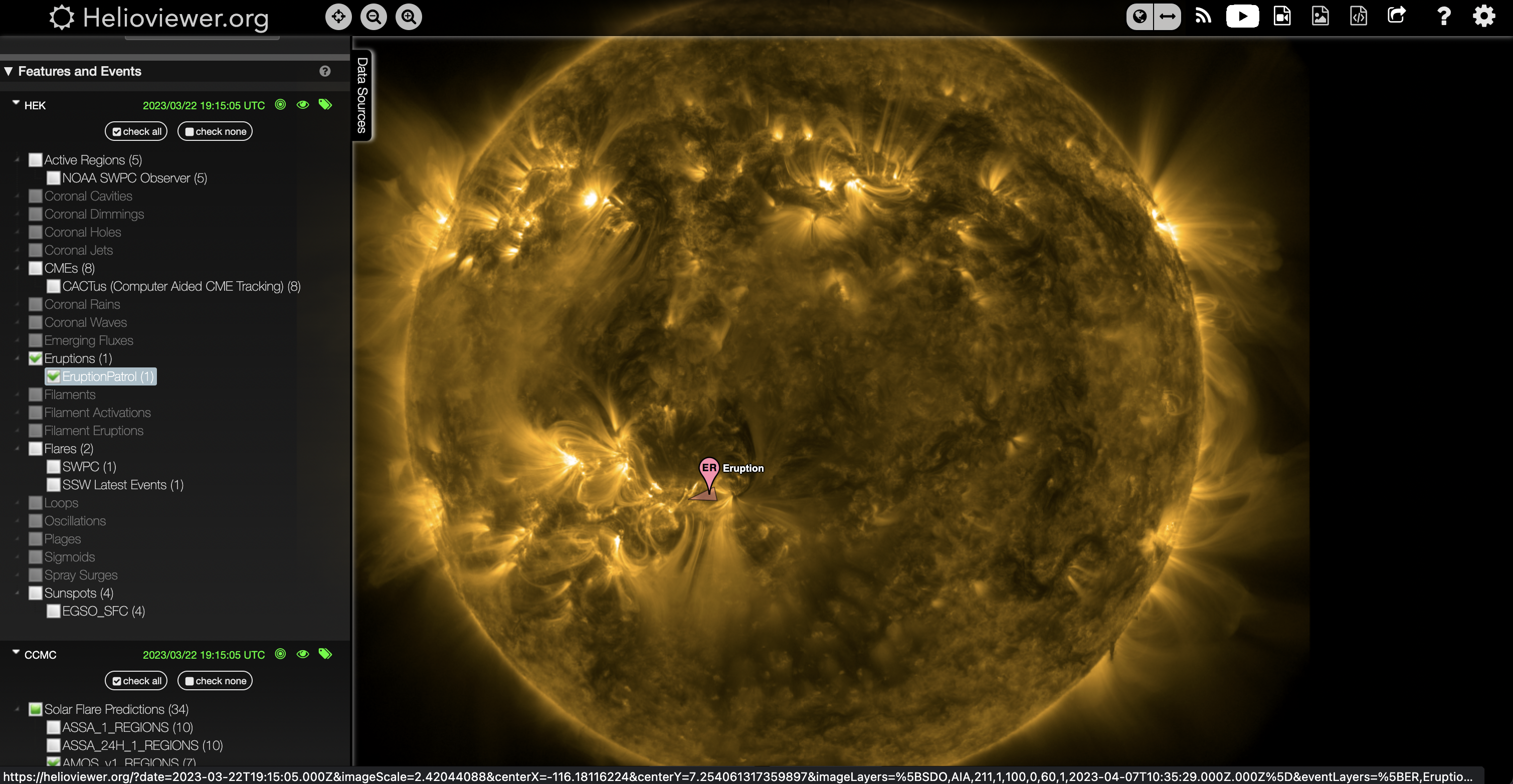
<p>When viewing RHESSI data, the RHESSI section under Features and Events can
be used to get more information about the observed flare.</p>

<p><img src="/images/uploads/2024/rhessi_img.jpg" alt="Example of a RHESSI image" /></p>

<p>Selecting the flare pin will reveal the flare’s event information.</p>

<p><img src="/images/uploads/2024/rhessi_popup.jpg" alt="Image of RHESSI Flare event popup which contains the flare's start time, end time, and a link to the full analysis" /></p>

<p>Selecting Full analysis will take you to that flare’s analysis page
within the <a href="https://umbra.nascom.nasa.gov/rhessi/rhessi_extras/flare_images_v2/hsi_flare_image_archive.html">RHESSI Image Archive</a>.</p>

<p><img src="/images/uploads/2024/rhessi_archive.jpg" alt="Screenshot of RHESSI Flare Analysis" /></p>

<h2 id="new-features">New Features</h2>

<p>These new features now improve the sharing and browsing capabilities of <a href="https://helioviewer.org">Helioviewer.org</a>.</p>

<h3 id="new-permanent-sharing-urls">New Permanent Sharing URLs</h3>

<p>Viewport sharing has been available in Helioviewer for some time, however
previous short links were temporary. The new sharing links are permanent
links to the current viewport. These links will load Helioviewer with the same
observation time, images, and event selections that were present when the link was created.</p>

<p><img src="/images/uploads/2024/sharing.jpg" alt="Share link to current viewport dialog" /></p>

<h3 id="image-date-warning">Image Date Warning</h3>

<p>When the observation date and the timestamp of the nearest image available
for that observation date are more than 12 hours apart, a warning will appear.
Helioviewer always shows the nearest available image, even if that image happens
to be years away, which can cause some confusion when overlaying multiple data
sources.</p>

<p>Previously, the only indicator for this is the image date turning red in the
sidebar. Now it also comes with a warning that you may use to update the
observation time, if desired.</p>

<p><img src="/images/uploads/2024/nearest_warning.jpg" alt="Image displays a screenshot of the warning about the time difference between the newest RHESSI Image (2012-07-05 23:58:09) and the specified observation date (2024-07-15 00:00:00)" /></p>

<h3 id="individual-event-selection">Individual Event Selection</h3>

<p>Individual events can now be shown or hidden, instead of only being able to
control groups of events. This also applies to any screenshots and movies
that you make.</p>

<p><img src="/images/uploads/2024/events.jpg" alt="Image of events with checkboxes for individual events" /></p>

<h3 id="jump-to-next-image">Jump to next image</h3>

<p>Navigating a specific set of images is now easier by using new buttons which
update the observation time to the timestamp of the next (or previous) image in the selected
data source.
Using the <img style="vertical-align: middle; padding-bottom: 3px; display: inline;" alt="forward and back" src="/images/uploads/2024/fwd_back.png" /> buttons, you can update the image to the next image for
that data source.</p>

<p><img src="/images/uploads/2024/jump_to_next_img.jpg" alt="Image of RHESSI data source selection" /></p>]]></content><author><name>Daniel Garcia Briseno</name></author><category term="Release" /><summary type="html"><![CDATA[New data sources and features are now available on Helioviewer.org.]]></summary></entry><entry><title type="html">Helioviewer Maintenance</title><link href="https://helioviewer-project.github.io/2024/07/15/maintenance" rel="alternate" type="text/html" title="Helioviewer Maintenance" /><published>2024-07-15T15:55:00+00:00</published><updated>2024-07-15T15:55:00+00:00</updated><id>https://helioviewer-project.github.io/2024/07/15/maintenance_complete</id><content type="html" xml:base="https://helioviewer-project.github.io/2024/07/15/maintenance"><![CDATA[<p>Maintenance on helioviewer.org is complete.</p>

<p>Helioviewer as been updated to version 4.4.0.
Another announcement highlighting new features will follow later this week.</p>

<p>For a full list of what’s new, you can view the full changelogs for the <a href="https://github.com/Helioviewer-Project/api/releases/tag/4.4.0">API</a> and <a href="https://github.com/Helioviewer-Project/helioviewer.org/releases/tag/4.4.0">Website</a></p>

<p>If you observe any issues, please create an issue on our issue tracker on <a href="https://github.com/Helioviewer-Project/helioviewer.org/issues/new/choose">Github</a>
or email us at <a href="mailto:helioviewerdevelopment@nasa.onmicrosoft.com">helioviewerdevelopment@nasa.onmicrosoft.com</a></p>]]></content><author><name>Daniel Garcia Briseno</name></author><category term="Maintenance" /><summary type="html"><![CDATA[Maintenance on helioviewer.org is complete.]]></summary></entry><entry><title type="html">Temporary SDO/LMSAL Outage</title><link href="https://helioviewer-project.github.io/2024/06/27/lmsal-outage" rel="alternate" type="text/html" title="Temporary SDO/LMSAL Outage" /><published>2024-06-27T05:00:00+00:00</published><updated>2024-06-27T05:00:00+00:00</updated><id>https://helioviewer-project.github.io/2024/06/27/lmsal-outage</id><content type="html" xml:base="https://helioviewer-project.github.io/2024/06/27/lmsal-outage"><![CDATA[<p>2024-07-02 Update: SDO data observed during the outage is available on Helioviewer.</p>

<p>The data center managed by Lockheed Martin Solar &amp; Astrophysics Lab (LMSAL)
will be offline between June 28, 5:00pm Pacific Time to late night June 29.</p>

<p>Helioviewer pulls SDO data from LMSAL so the latest SDO data will not
be available during this time. There will be a gap in
the data after the data center comes back online which will be filled in
next week.</p>]]></content><author><name>Daniel Garcia Briseno</name></author><category term="Outages" /><summary type="html"><![CDATA[2024-07-02 Update: SDO data observed during the outage is available on Helioviewer.]]></summary></entry><entry><title type="html">Helioviewer Maintenance</title><link href="https://helioviewer-project.github.io/2024/06/20/maintenance" rel="alternate" type="text/html" title="Helioviewer Maintenance" /><published>2024-06-21T05:00:00+00:00</published><updated>2024-06-21T05:00:00+00:00</updated><id>https://helioviewer-project.github.io/2024/06/20/maintenance</id><content type="html" xml:base="https://helioviewer-project.github.io/2024/06/20/maintenance"><![CDATA[<p>Update 2024-07-15: This maintenance is complete.</p>

<p><a href="https://helioviewer.org">helioviewer.org</a> will be undergoing scheduled maintenance on Monday July 15
from 9:00am - 2:00pm US/Eastern time.</p>

<p>During this time you can expect the following:</p>
<ul>
  <li>helioviewer.org may appear to load, but not function properly</li>
  <li>JHelioviewer users may not be able to load data from GSFC</li>
</ul>

<p>You may use the Helioviewer mirror at <a href="https://helioviewer.ias.u-psud.fr/">IAS</a></p>]]></content><author><name>Daniel Garcia Briseno</name></author><category term="Maintenance" /><summary type="html"><![CDATA[Update 2024-07-15: This maintenance is complete.]]></summary></entry></feed>